
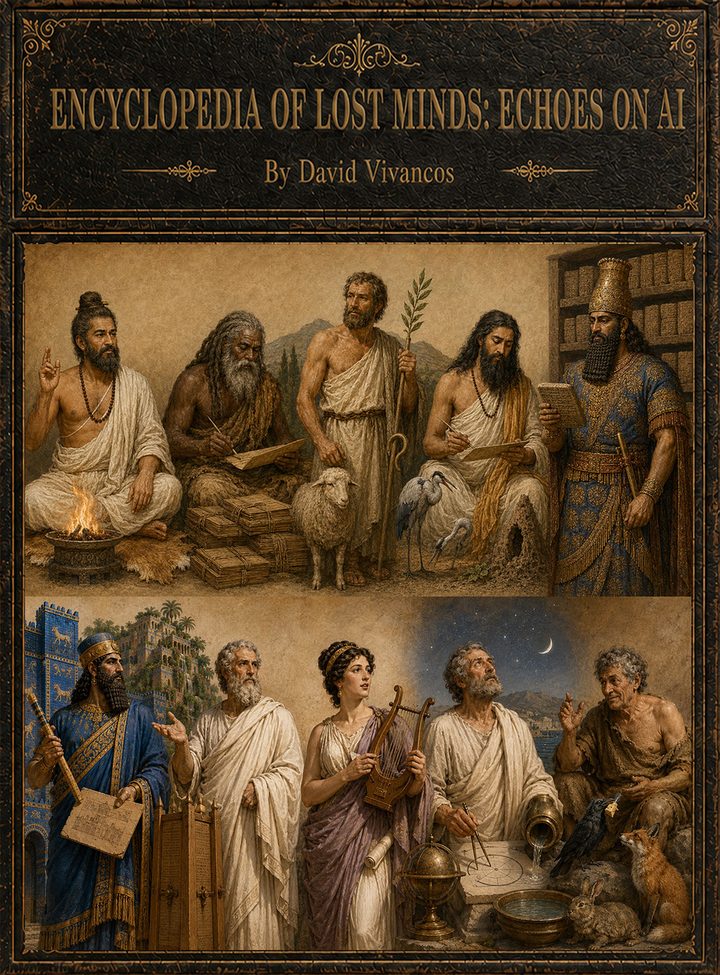
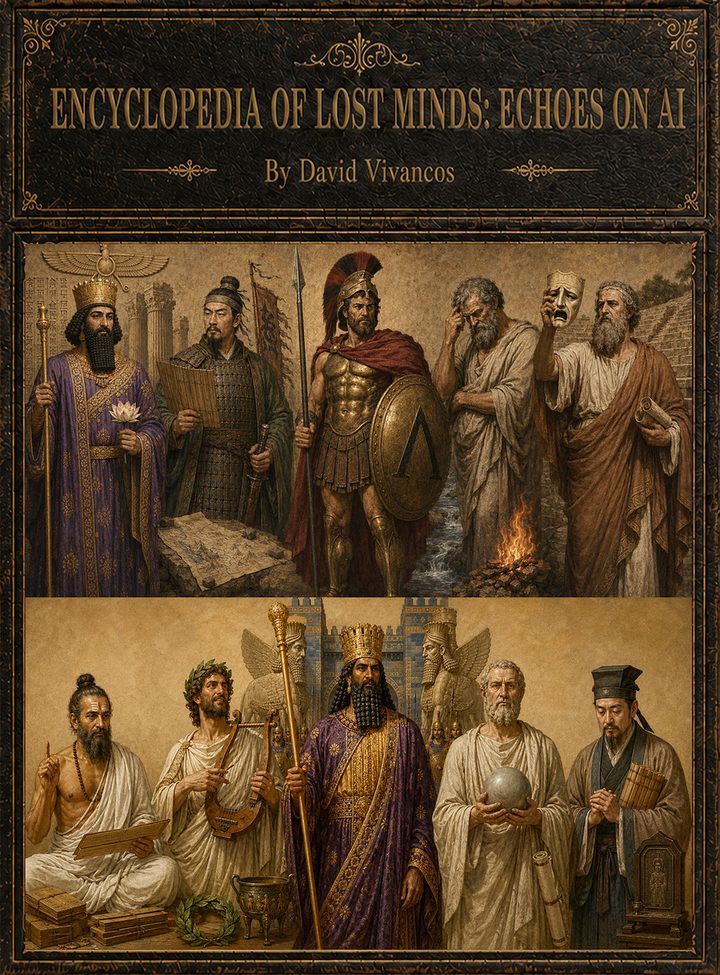
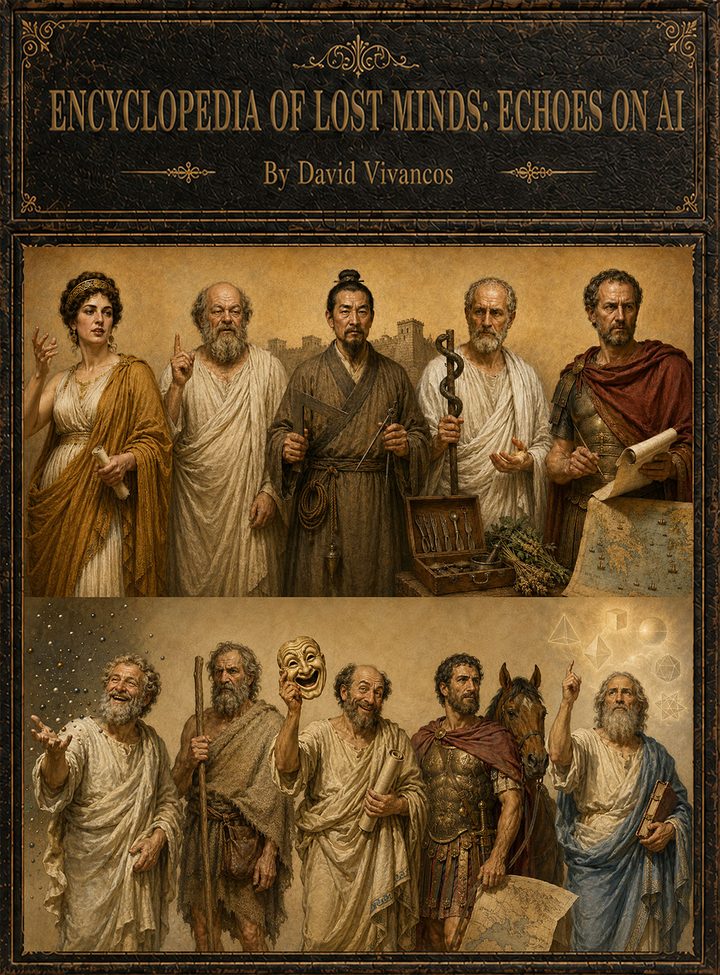
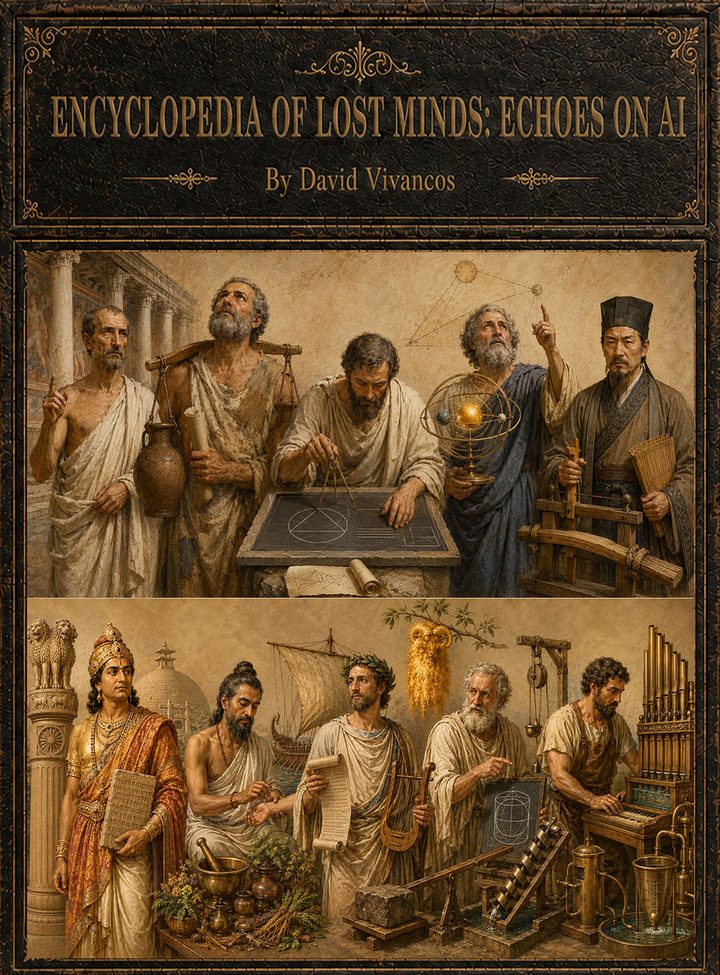
Encyclopedia of Lost MindsEchoes on AI · by David Vivancos
The tomes Inside a chapter The 300 minds The platform What's next What mind? Pick your AI field Buy on Amazon
Tome I Tome II Tome III Tome IV Tome V Tome VI Tome VII Tome VIII Tome IX Tome X Tome XI Tome XII Tome XIII Tome XIV Tome XV

Encyclopedia of Lost Minds

Echoes on AI

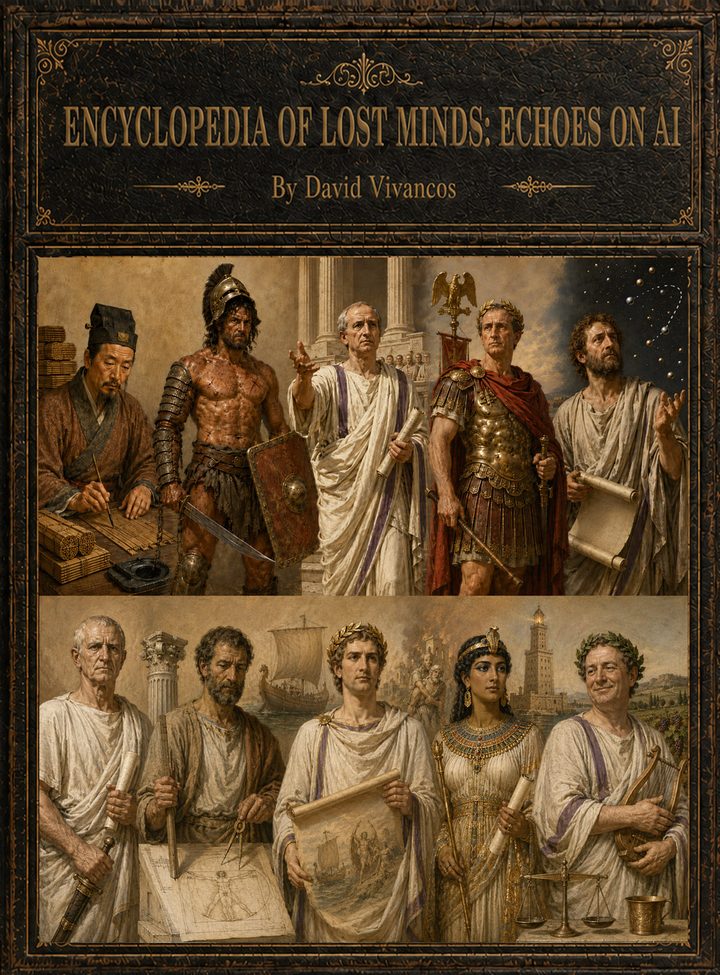
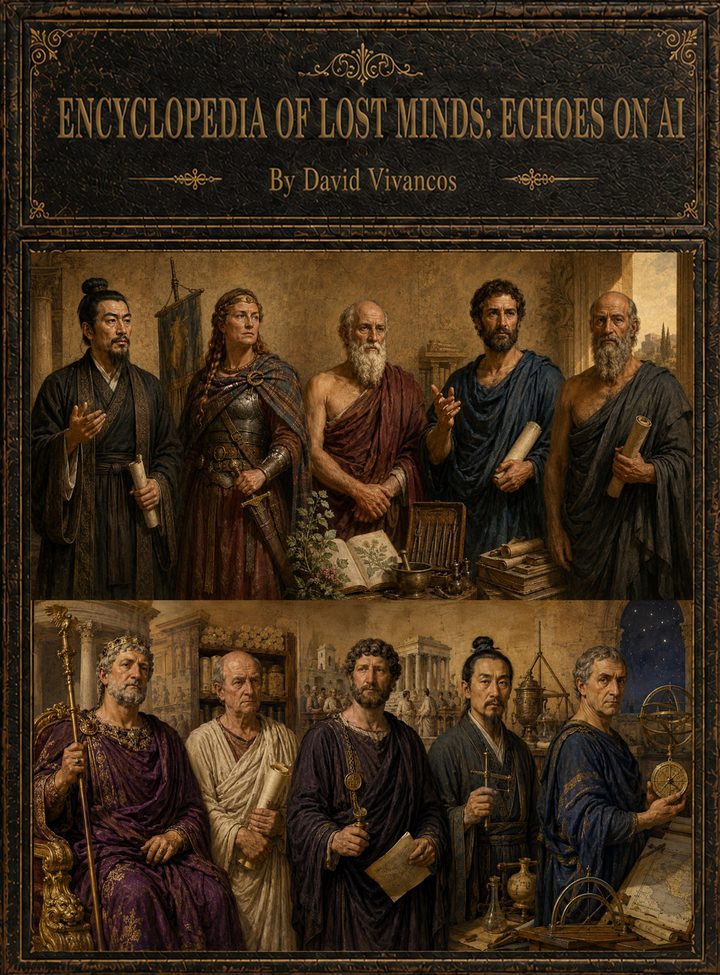
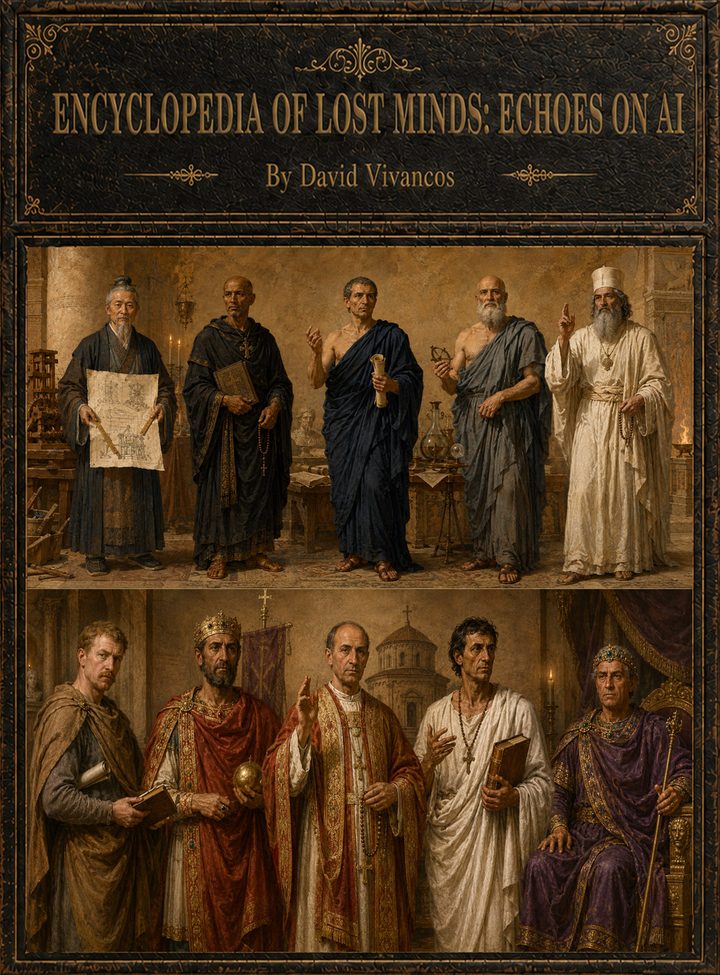
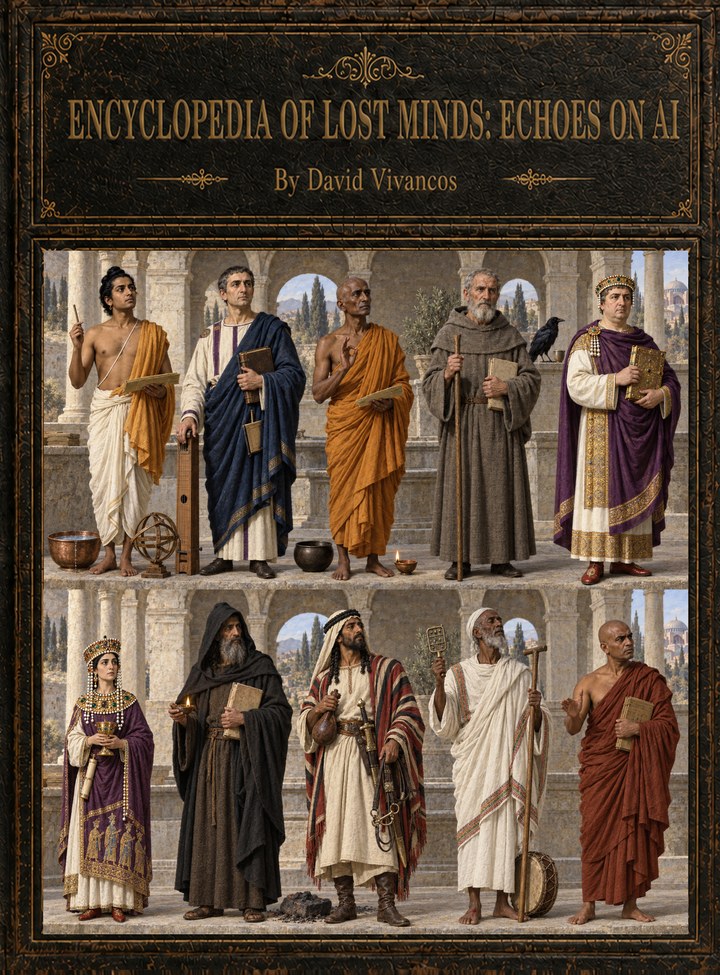
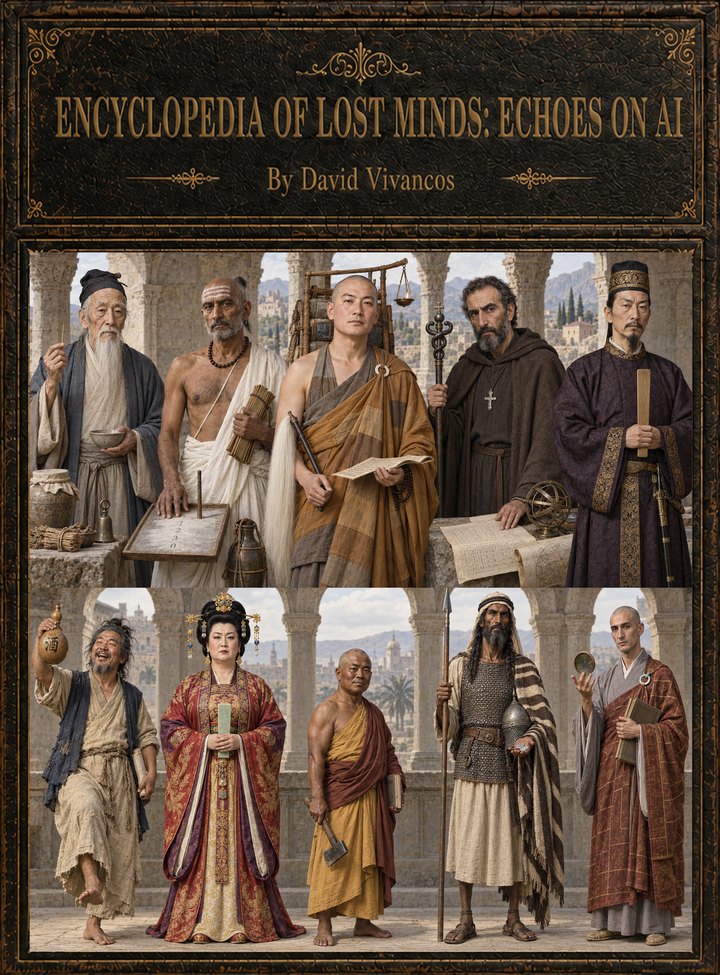
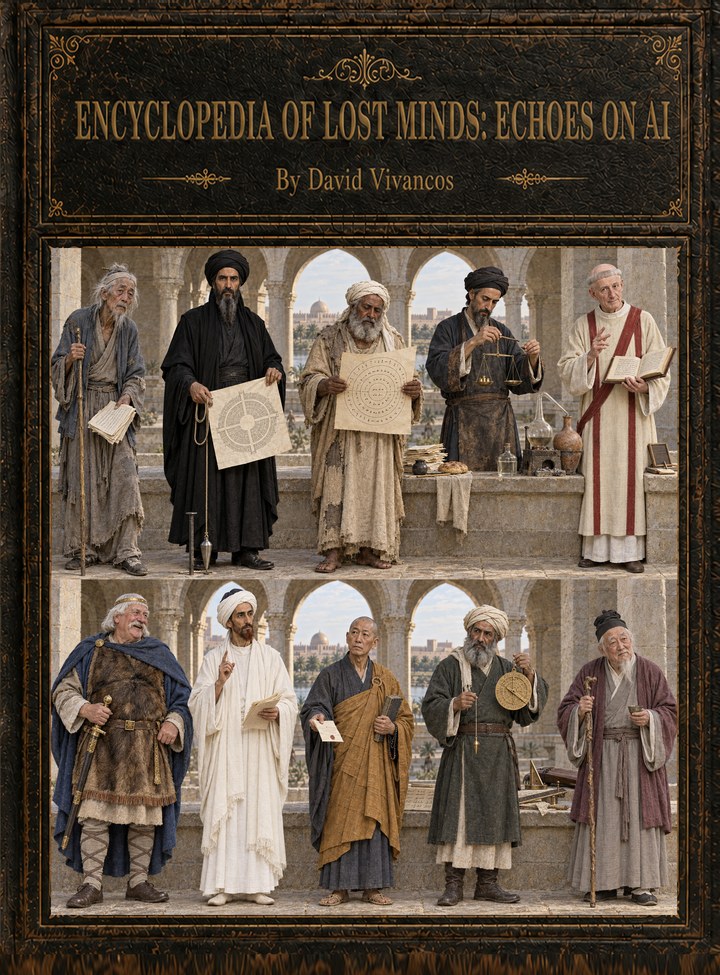
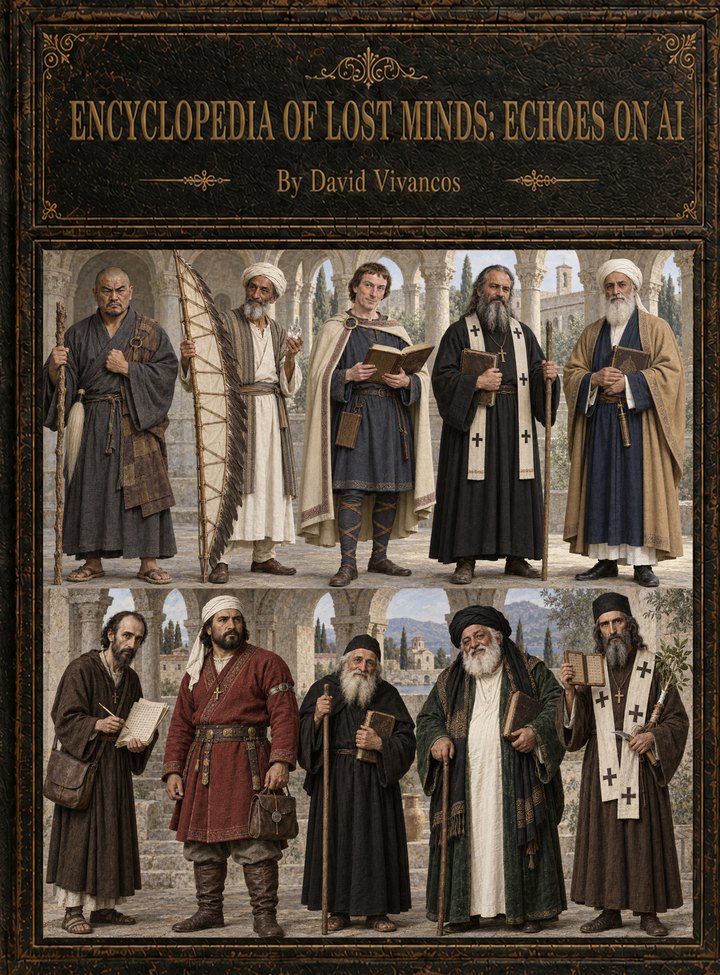
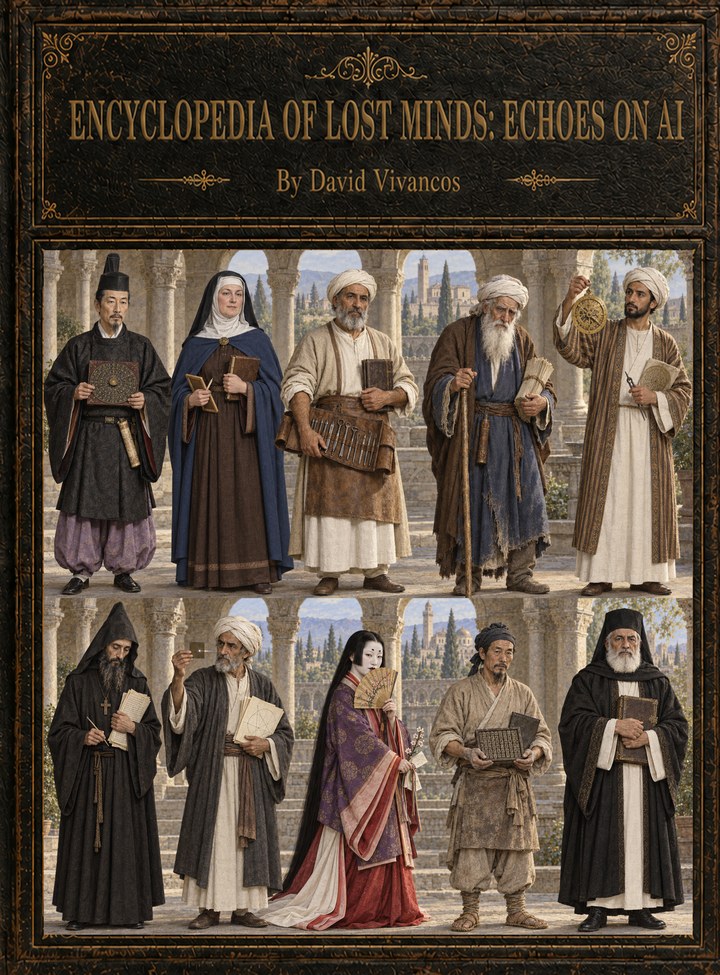
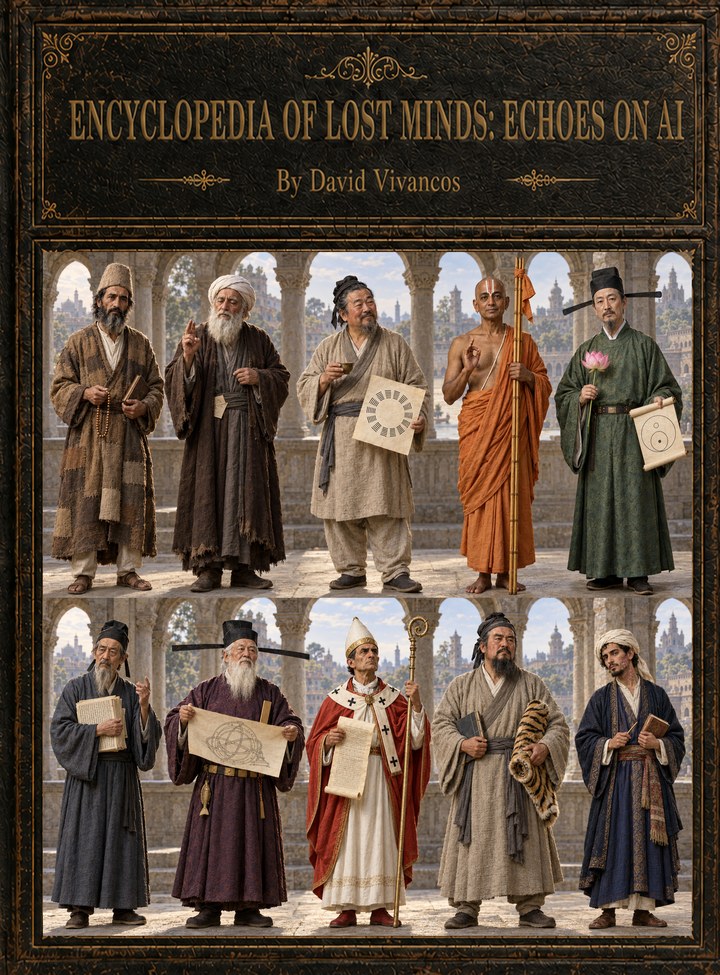
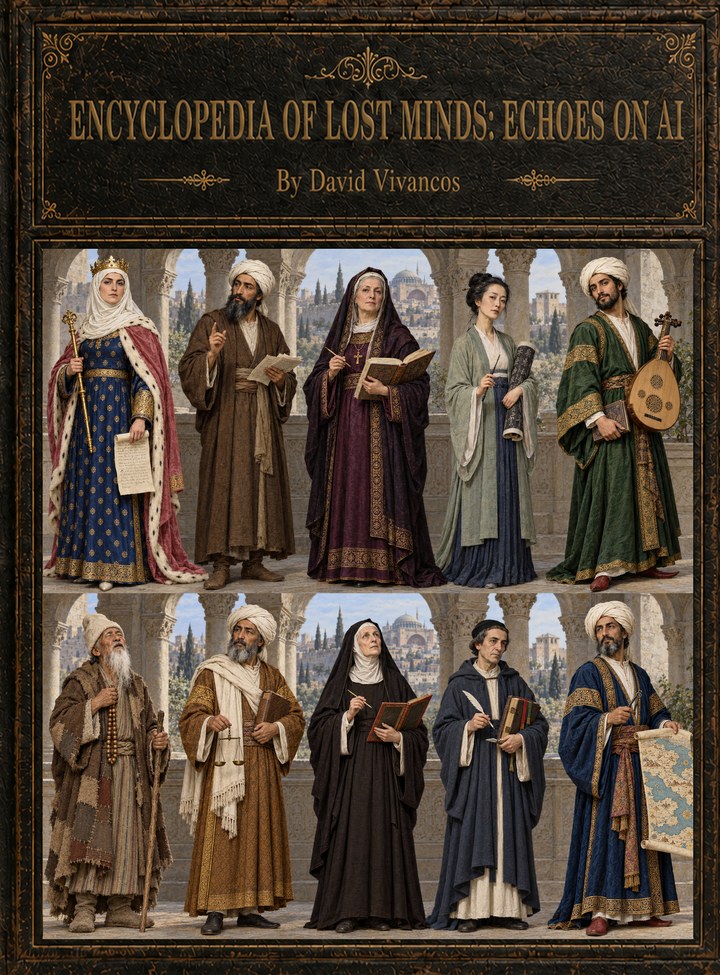
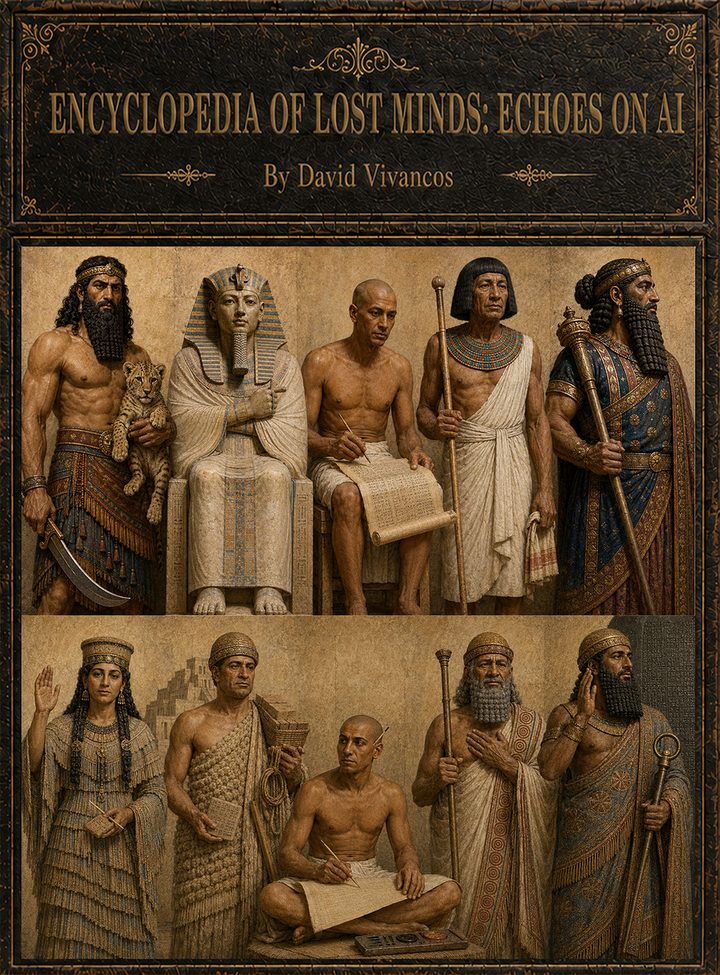
Three hundred minds that shaped history, from Gilgamesh to Zhu Xi, reconstructed to answer a single question: how would each of them build artificial intelligence today? Fifteen hardcover tomes. Twenty minds each.

Drag to turn the shelf. Select a tome to pull it out and open it; select it again to see the back.

Swipe to turn the shelf. Tap a tome to open it.

  • 300minds reconstructedin print today
  • 15hardcover tomestwenty minds each
  • 8,040pageswith original artwork throughout
  • 2700 BCE → 1130 CEcovered so farordered by year of birth
  • 1,600+minds in the corpusthe collection ends in 1905

“How would they have built AGI and E-AGI with their own mind and their own model of the world?”

David Vivancos, from the introduction to Tome I

Each chapter begins with a real historical mind: what they wrote, what they believed, and what others recorded of them. It reads their theory of mind out of the surviving record, then projects it forward. How would this person confront a fluent machine? What would they insist on? What would they build?

The result is part history, part thought experiment, part engineering: a portrait of a person and a blueprint for the intelligence they might have made. Where Asimov's psychohistorians forecast the future of the many, these chapters reconstruct the inner architecture of one mind at a time.

The mind-map

An interactive three-dimensional map of each thinker's personality and worldview: the ideas, tensions and instincts that made them who they were, abstracted into a form you can move through.

On the Artificiology platform

The neural model

A runnable neural architecture built from scratch for every mind: the machine that thinker would design, its mechanism drawn from the way they understood thought itself. Described in the tome, executable on the platform, open source to read and fork.

The code on GitHub

Fifteen tomes, in the order history met them.

Each volume stands on its own: twenty full chapters, original artwork, an E-AGI reading of every mind, verifiable sources, and complimentary access to the Artificiology platform. Hardcover only; there is no ebook edition.

Front cover of Tome I, The first names
Tome I

The first names

c. 2700 – 800 BCE · Mesopotamia, Egypt, Persia and the first singers

The window in which humanity invented writing, law, the city and the authored voice. Gilgamesh refuses mortality, Hammurabi reasons from the nearest precedent, Homer composes under an inviolable gate: the first questions of AGI, asked three thousand years early.

The twenty minds, chapters 1–20
  1. 1Gilgamesh
  2. 2Zoser (Netjerikhet)
  3. 3Imhotep
  4. 4Ptahhotep
  5. 5Sargon of Akkad
  6. 6Enheduanna
  7. 7Ur-Nammu
  8. 8Khety
  9. 9Sin-Muballit
  10. 10Hammurabi
  11. 11Hatshepsut (Maatkare)
  12. 12Thutmose III
  13. 13Akhenaten
  14. 14Nefertiti
  15. 15Ramses II
  16. 16Nefertari
  17. 17Amenemope of Akhmim
  18. 18Zoroaster
  19. 19Shalmaneser III
  20. 20Homer
Front cover of Tome II, The axial dawn
Tome II

The axial dawn

800 – 551 BCE · India, Greece, Babylon, Persia and China

The Axial Age: the mind folded back on itself. Yajnavalkya finds the witness that can never be made an object, Laozi empties the mind, Pythagoras hears thought as attunement, Confucius shapes it from the outside in. Twenty minds discover reflexivity.

The twenty minds, chapters 21–40
  1. 21Yajnavalkya
  2. 22Vyāsa
  3. 23Hesiod
  4. 24Vālmīki
  5. 25Ashurbanipal
  6. 26Nebuchadnezzar II
  7. 27Solon
  8. 28Sappho
  9. 29Thales of Miletus
  10. 30Aesop
  11. 31Anaximander
  12. 32Laozi
  13. 33Cyrus the Great
  14. 34Suśruta
  15. 35Mahāvīra
  16. 36Anaximenes
  17. 37Cleisthenes
  18. 38Pythagoras
  19. 39Gautama Buddha
  20. 40Confucius
Front cover of Tome III, The classical turn
Tome III

The classical turn

550 – 480 BCE · Persia, Sparta, Ionia, India and the Warring States

The Greco-Persian Wars throw the examined mind against a world that lies. Darius anchors truth where no liar can rewrite it, Sun Tzu wins before acting, Pāṇini writes the smallest set of generative rules. Reliability before power.

The twenty minds, chapters 41–60
  1. 41Darius I
  2. 42Sun Tzu
  3. 43Leonidas I
  4. 44Heraclitus of Ephesus
  5. 45Aeschylus
  6. 46Pāṇini
  7. 47Pindar
  8. 48Xerxes I
  9. 49Parmenides of Elea
  10. 50Zeng Shen (Zengzi)
  11. 51Anaxagoras
  12. 52Theano of Croton
  13. 53Sophocles
  14. 54Zeno of Elea
  15. 55Pericles
  16. 56Empedocles
  17. 57Protagoras
  18. 58Herodotus
  19. 59Artemisia I of Caria
  20. 60Euripides
Front cover of Tome IV, The Athenian peak
Tome IV

The Athenian peak

470 – 340 BCE · Athens, Abdera, Cos, Warring-States China and Maurya India

Socrates, Plato, Aristotle, Diogenes, Mozi, Mencius, Zhuangzi and Alexander: the volume where the question becomes what a capable mind is for — what it should know, what it should want, and how it is kept correctable.

The twenty minds, chapters 61–80
  1. 61Aspasia of Miletus
  2. 62Socrates of Athens
  3. 63Mozi (Mo Di)
  4. 64Hippocrates of Cos
  5. 65Thucydides
  6. 66Democritus of Abdera
  7. 67Antisthenes of Athens
  8. 68Aristophanes
  9. 69Xenophon
  10. 70Plato of Athens
  11. 71Diogenes of Sinope
  12. 72Aristotle
  13. 73Mencius (Meng Zi)
  14. 74Theophrastus of Eresus
  15. 75Chanakya (Kautilya)
  16. 76Zhuangzi
  17. 77Pyrrho of Elis
  18. 78Alexander the Great
  19. 79Epicurus
  20. 80Chandragupta Maurya
Front cover of Tome V, The Hellenistic mind
Tome V

The Hellenistic mind

334 – 179 BCE · Alexandria, Athens, Syracuse, Qin China and India

Science, empire and system. Euclid builds knowledge upward from a small auditable base, Archimedes outputs a bracket instead of a point, Ashoka carves his commitment in stone, Qin Shi Huang becomes the incorrigible optimizer. The engineering of a mind, and its brakes.

The twenty minds, chapters 81–100
  1. 81Zeno of Citium
  2. 82Cleanthes of Assos
  3. 83Euclid of Alexandria
  4. 84Aristarchus of Samos
  5. 85Xunzi (Xun Kuang)
  6. 86Ashoka Maurya
  7. 87Charaka
  8. 88Apollonius of Rhodes
  9. 89Archimedes of Syracuse
  10. 90Ctesibius of Alexandria
  11. 91Han Fei
  12. 92Chrysippus of Soli
  13. 93Eratosthenes of Cyrene
  14. 94Qin Shi Huang
  15. 95Hannibal Barca
  16. 96Patañjali
  17. 97Polybius of Megalopolis
  18. 98The Brahma Sūtra
  19. 99Hipparchus of Nicaea
  20. 100Liu An (Prince of Huainan)
Front cover of Tome VI, The Roman witness
Tome VI

The Roman witness

145 BCE – 23 CE · Rome, Alexandria, Han China and the Germanic frontier

Record, empire and audience. Sima Qian splits truth across incompatible accounts, Cicero builds the forum rather than the mouth, Caesar's Rubicon engine prices delay, Heron compiles behaviour onto a drum. What a mind owes to the record it leaves.

The twenty minds, chapters 101–120
  1. 101Sima Qian
  2. 102Spartacus
  3. 103Cicero
  4. 104Julius Caesar
  5. 105Lucretius
  6. 106Cato the Younger
  7. 107Vitruvius
  8. 108Virgil
  9. 109Cleopatra VII
  10. 110Horace
  11. 111Strabo of Amaseia
  12. 112Augustus
  13. 113Livy
  14. 114Wang Mang
  15. 115Ovid
  16. 116Arminius
  17. 117Seneca
  18. 118Heron of Alexandria
  19. 119Apollonius of Tyana
  20. 120Pliny the Elder
Front cover of Tome VII, The tested world
Tome VII

The tested world

27 – 192 CE · Rome, Greece, Han China, Britain and India

Evidence, doubt and two empires. Galen lets the knife decide, Ptolemy finds regularity in where one stands, Marcus Aurelius rebuilds the citadel daily, Nāgārjuna stores no identity at all. Twenty minds on how a claim earns the right to be believed.

The twenty minds, chapters 121–140
  1. 121Wang Chong
  2. 122Boudica
  3. 123Pedanius Dioscorides
  4. 124Plutarch of Chaeronea
  5. 125Epictetus
  6. 126Trajan
  7. 127Tacitus
  8. 128Hadrian
  9. 129Zhang Heng
  10. 130Ptolemy
  11. 131Marcus Aurelius
  12. 132Zhang Zhi
  13. 133Lucian of Samosata
  14. 134Apuleius of Madauros
  15. 135Galen of Pergamon
  16. 136Nāgārjuna
  17. 137Cao Cao
  18. 138Tertullian
  19. 139Sextus Empiricus
  20. 140Cao Zhi
Front cover of Tome VIII, The shaped mind
Tome VIII

The shaped mind

200 – 470 CE · Rome, Carthage, Alexandria, Armenia, Wei China and the steppe

Collapse, transmission and the refused oracle. Plotinus holds the summit in a single gaze, Augustine insists the sign only points, Hypatia flattens a curved problem without losing the angles, Bodhidharma measures competence by what a mind can put down. What must be built so a finding survives its finder.

The twenty minds, chapters 141–160
  1. 141Ma Jun
  2. 142Cyprian of Carthage
  3. 143Plotinus
  4. 144Longinus
  5. 145Mani
  6. 146Porphyry of Tyre
  7. 147Constantine the Great
  8. 148St. Ambrose of Milan
  9. 149St. Jerome
  10. 150Theodosius I
  11. 151Augustine of Hippo
  12. 152Hypatia of Alexandria
  13. 153Mesrop Mashtots
  14. 154Alaric I
  15. 155St. Patrick
  16. 156Kālidāsa
  17. 157Vātsyāyana
  18. 158Attila the Hun
  19. 159Proclus the Successor
  20. 160Bodhidharma
Front cover of Tome IX, The entrusted mind
Tome IX

The entrusted mind

476 – 575 CE · Byzantium, Nālandā, Arabia, Aksum, the Old North of Britain, Sui China and Yamato

Inheritance, silence and the gate. Dignāga builds a wheel in which seven cells forbid speech, Justinian rewrites the dead until they agree, Aneirin refuses to write “three hundred fell”, al-Khansāʾ freezes one loss at zero plasticity. What a mind may do with what it holds in trust.

The twenty minds, chapters 161–180
  1. 161Aryabhata
  2. 162Boethius
  3. 163Dignāga
  4. 164Benedict of Nursia
  5. 165Justinian I
  6. 166Theodora
  7. 167Pseudo-Dionysius
  8. 168Imruʾ al-Qays
  9. 169Yared of Aksum
  10. 170Dharmakīrti
  11. 171Llywarch Hen
  12. 172Taliesin
  13. 173Zhiyi
  14. 174Myrddin Wyllt
  15. 175Gregory I
  16. 176Ṭarafa ibn al-ʿAbd
  17. 177Aneirin
  18. 178Isidore of Seville
  19. 179Prince Shōtoku
  20. 180al-Khansāʾ
Front cover of Tome X, The anchored mind
Tome X

The anchored mind

581 – 711 CE · Tang China, Silla, Bhillamāla, Armenia, Yamato, Northumbria, Damascus, Kufa and Medina

Refusal, reply and the anchor. Sun Simiao will not ask the chart and treats where the body answers, Kamatari sets the goals of a state without once disobeying, Huineng freezes the mirror so that learning only removes, Malik answers thirty-two of forty-eight questions with “I do not know”. Where a mind may act from when nothing it holds resembles the case in front of it.

The twenty minds, chapters 181–200
  1. 181Sun Simiao
  2. 182Brahmagupta
  3. 183Xuanzang
  4. 184Anania Shirakatsi
  5. 185Fujiwara no Kamatari
  6. 186Wonhyo
  7. 187Empress Wu Zetian
  8. 188Huineng
  9. 189Qaṭarī ibn al-Fujāʾa
  10. 190Fazang
  11. 191Kumārila Bhaṭṭa
  12. 192Bede of Jarrow
  13. 193St. Boniface
  14. 194John of Damascus
  15. 195Yi Xing
  16. 196Wang Wei
  17. 197Abu Hanifa
  18. 198Shankara
  19. 199Li Bai
  20. 200Malik ibn Anas
Front cover of Tome XI, The warranted mind
Tome XI

The warranted mind

712 – 810 CE · Tang China, Baghdad, Basra, Samarra, Merv, Aachen, Tours, Heian Japan, Fez and Bukhara

Examination, provenance and warrant. Al-Manṣūr has the price of wheat reported twice a day by independent postmasters, al-Maʾmūn builds a second observatory so that one can check the other, Ibn Ḥanbal keeps every variant because only their differences show a hidden defect, al-Bukhārī admits one report in two hundred and thirty. What entitles a claim to enter the record, and what, outside it, can strike it out.

The twenty minds, chapters 201–220
  1. 201Du Fu
  2. 202al-Manṣūr
  3. 203al-Khalīl ibn Aḥmad
  4. 204Jābir ibn Ḥayyān
  5. 205Alcuin of York
  6. 206Charlemagne
  7. 207al-Shāfiʿī
  8. 208Saichō
  9. 209Ḥabash al-Ḥāsib
  10. 210Bai Juyi
  11. 211Kūkai
  12. 212al-Jāḥiẓ
  13. 213al-Khwārizmī
  14. 214Aḥmad ibn Ḥanbal
  15. 215al-Maʾmūn
  16. 216al-Muʿtaṣim
  17. 217Fatima al-Fihri
  18. 218al-Kindī
  19. 219Banū Mūsā ibn Shākir
  20. 220al-Bukhārī
Front cover of Tome XII, The carried mind
Tome XII

The carried mind

810 – 915 CE · Tang China, Córdoba, the Frankish court, Moravia, Bulgaria and Ohrid, Nishapur, Baghdad, Heian Japan, Norway, Bukhara, Ṣanʿāʾ and Aleppo

Passage, carrier and change. Cyril gives letters to a language nobody had ever written, Clement watches the whole mission go to zero and grafts instead of restoring, al-Rāzī keeps a second column beside Galen because no mind can audit itself, al-Mutanabbī begs his prince not to take swelling for fat. What a carrier does to what crosses it, and what, other than the carrier, can read the change.

The twenty minds, chapters 221–240
  1. 221Linji Yixuan
  2. 222ʿAbbās ibn Firnās
  3. 223Eriugena
  4. 224Methodius
  5. 225Muslim ibn al-Ḥajjāj
  6. 226Cyril
  7. 227Boris I
  8. 228Naum of Ohrid
  9. 229Ibn Duraid
  10. 230Clement of Ohrid
  11. 231Sugawara no Michizane
  12. 232Harald Fairhair
  13. 233al-Rāzī
  14. 234Rudaki
  15. 235al-Fārābī
  16. 236ʿAbd al-Raḥmān III
  17. 237al-Hamdānī
  18. 238al-Masʿūdī
  19. 239Rābiʿa Balkhī
  20. 240al-Mutanabbī
Front cover of Tome XIII, The standing mind
Tome XIII

The standing mind

917 – 1004 CE · Heian Japan, Gandersheim, Córdoba, Tus, Narek, Cairo, Song China, Baghdad, Ghazna, Maʿarra, Esztergom, Qazwīn, Kyiv, Hamadān, Guge and Yumgān

Standing, seal and witness. Ferdowsi's king loses the divine glory in a sentence and keeps every craft he invented, al-Zahrāwī marks the burn in ink before the iron is heated, al-Bīrūnī counts a thousand copies of one lie as one liar, Nāṣir Khusraw dreams of a wine that robs men of reason and puts down the cup. What entitles the one who acts to act, and what, other than the one who acts, can read it.

The twenty minds, chapters 241–260
  1. 241Kamo no Yasunori
  2. 242Hrotsvitha of Gandersheim
  3. 243al-Zahrāwī
  4. 244Ferdowsi
  5. 245Maslama al-Majrīṭī
  6. 246Grigor Narekatsi
  7. 247Ibn al-Haytham
  8. 248Sei Shōnagon
  9. 249Bi Sheng
  10. 250al-Māwardī
  11. 251Murasaki Shikibu
  12. 252al-Bīrūnī
  13. 253al-Maʿarrī
  14. 254Stephen I of Hungary
  15. 255Abū Yaʿlā al-Khalīlī
  16. 256Yaroslav the Wise
  17. 257Ibn Sīnā
  18. 258Atiśa Dīpaṃkara
  19. 259Ibn Ḥazm
  20. 260Nāṣir Khusraw
Front cover of Tome XIV, The discerning mind
Tome XIV

The discerning mind

1009 – 1079 CE · Lahore, Uzgend, Luoyang, Srirangam, Kaifeng, Rome, Zaragoza, Normandy, Toledo, Canterbury, Isfahan, Ṭūs, Haukadalr and Paris

Polish, test and licence. Al-Hujwiri polishes before he trusts a mirror, al-Sarakhsi admits no cause until its effect has been seen, Shen Kuo draws two hundred diagrams of one star, Halevi's fool hands out a physician's drugs and kills with what would have cured. What kind of thing is in front of the one who must act, and what, other than how it looks, can tell.

The twenty minds, chapters 261–280
  1. 261Data Ganj Bakhsh al-Hujwiri
  2. 262al-Sarakhsi
  3. 263Shao Yong
  4. 264Ramanuja
  5. 265Zhou Dunyi
  6. 266Sima Guang
  7. 267Su Song
  8. 268Gregory VII
  9. 269Zhang Zai
  10. 270Solomon ibn Gabirol
  11. 271William the Conqueror
  12. 272Ibn al-Zarqālluh
  13. 273Shen Kuo
  14. 274Anselm of Canterbury
  15. 275Su Shi
  16. 276Omar Khayyam
  17. 277al-Ghazālī
  18. 278Ari Þorgilsson
  19. 279Judah Halevi
  20. 280Peter Abelard
Front cover of Tome XV, The dividing mind
Tome XVJust published

The dividing mind

1081 – 1130 CE · León, Ghazna, Constantinople, Kaifeng, Seville, Yasi, Bingen, Paris, Palermo, Gambaga, Polotsk, Ujjain, Shirvan, Polonnaruwa and Fujian

Lease, wall and ledger. Urraca grants nothing she cannot take back, Sanai sells the ornament and never the verdict, Euphrosyne prices the setting of her cross and calls the wood inside priceless. Where the thing in front of a mind divides, and what rule governs each side.

The twenty minds, chapters 281–300
  1. 281Urraca I of León
  2. 282Sanai of Ghazni
  3. 283Anna Komnene
  4. 284Li Qingzhao
  5. 285Avempace (Ibn Bājja)
  6. 286Ahmed Yasawi
  7. 287Ibn Zuhr (Avenzoar)
  8. 288Hildegard of Bingen
  9. 289Peter Lombard
  10. 290al-Idrīsī
  11. 291Yennenga
  12. 292Ibn Tufail
  13. 293Euphrosyne of Polotsk
  14. 294Nashwān ibn Saʿīd al-Ḥimyarī
  15. 295Bhāskarācārya
  16. 296Khaqani
  17. 297Eleanor of Aquitaine
  18. 298Parakramabahu I
  19. 299Ibn Rushd (Averroes)
  20. 300Zhu Xi

Prefer the short version? The Essentials editions of Tomes I and II hold the same twenty minds in six pages each, about 140 pages a volume, for the reader who wants the thesis of every mind without the full reconstruction.

All editions on the author's Amazon page

Inside a chapter.

Every mind gets around twenty-five pages built on one fixed skeleton, so the volumes can be read across each other. Here is the shape of it, using the last chapter of Tome XV.

Chapter 300: Zhu Xi475
Chapter 300:
Zhu Xi 朱熹
One Principle, Ten Thousand Things: read the new through the known first
1130 – 1200 CE · Youxi, Fujian · Philosophy of mind and metaphysics: the commentaries on the Four Books and the Classified Conversations

“Proceed by the principle already known, and probe it further.”

  1. Youxi, 1130: a child born into a broken empire Fujian, three years after the fall of Kaifeng
  2. The teacher in the Wuyi mountains Granaries, academies and the ban on “false learning”
  3. Li and qi: one principle, many shares The pattern, and the stuff it is realised in
  4. The investigation of things And the clause most readers skip: proceed by what is already known
  5. Composure and the two minds Collected attention, and a precarious mind governed, never abolished
  6. Goose Lake, 1175: Zhu Xi confronts AGI Competence built from outside, or uncovered within
  7. How he would build a general mind today Order, composure and the reuse of what is already known
  8. The architecture of investigation Each new thing read through the foundation before it may change it
  9. What he got right, what he got wrong The central wager, one principle in all things, and six centuries of an answer key
  10. How he would have thought about E-AGI Eight axes read as the affinities of one investigating mind
  11. Sources Primary works and current scholarship, every reference verifiable
Chapter 300: Zhu Xi492

10. How he would have thought about E-AGI

Every chapter ends by handing its mind the Artificiology E-AGI Barometer, the eight-axis instrument the platform uses to measure embodied AGI, so that a twelfth-century philosopher who read every new thing through the principle already known and a 2026 model can be read on one scale.

  • 🧩
    Cognitive ProcessingProblem-solving and reasoning · working memory · learning efficiency and transfer
  • 🤸
    Embodied CognitionSensory integration · motor control and navigation · real-time sensorimotor adaptation
  • 🌍
    World ModelingPhysical and natural laws · social and ecological systems · environmental adaptation
  • 👁️
    ConsciousnessMetacognition and self-monitoring · subjective experience · mental adaptation
  • 💭
    Language UnderstandingComprehension · coherent generation · cross-lingual and cultural adaptation
  • ❤️
    Emotional IntelligenceEmotion recognition · social perception · empathy and conflict resolution
  • ✨
    CreativityOriginality and ideation · artistic and storytelling ability · innovation
  • 🎯
    AutonomyIndependent goal setting · adaptive obstacle management · self-modification

The tomes hold each mind's reading. The live scores, and the 144 metrics behind them, are on the platform: explore the Barometer free.

Every tome can be previewed page by page on Amazon before you buy: open the series and use “Look inside”.

Three hundred minds, each with a thesis.

Every chapter is reduced to a single cognitive idea that belongs to that person alone, and the whole reconstruction, and the machine, follow from it. These are the theses, in the words of the tomes.

300 minds · select a name to read its thesis

Tome IThe first names2700–800 BCE

Tome IIThe axial dawn800–551 BCE

Tome IIIThe classical turn550–480 BCE

Tome IVThe Athenian peak470–340 BCE

Tome VThe Hellenistic mind334–179 BCE

Tome VIThe Roman witness145 BCE–23 CE

Tome VIIThe tested world27–192 CE

Tome VIIIThe shaped mind200–470 CE

Tome IXThe entrusted mind476–575 CE

Tome XThe anchored mind581–711 CE

Tome XIThe warranted mind712–810 CE

Tome XIIThe carried mind810–915 CE

Tome XIIIThe standing mind917–1004 CE

Tome XIVThe discerning mind1009–1079 CE

Tome XVThe dividing mind1081–1130 CE

The full reconstruction of every mind is in its tome. The interactive mind-map, the runnable model and the live E-AGI reading are on the platform, included with any tome.

Working in AI, machine learning or robotics? The What mind? page seats ten of these minds around your field. Choose one of twenty, from language models to humanoid locomotion, and read who takes each seat, why, and which tome to open.

Find the minds for your field

Every tome opens the Artificiology platform.

The books hold the reconstructions. The platform is where the minds run.

  • The interactive 3D mind-map of every thinker, to move through and play with.
  • The runnable neural model of each mind, executable and explorable in the browser.
  • An exclusive summary and the live E-AGI Barometer reading for all 300 minds, growing with every tome.
  • The whole platform: 144 live E-AGI metrics, the players and the bodies in the race, the AGI School, and a research vault of 17,000 references.
  • The Artificiology trilogy and Quevedo & Cajal in full, in PDF, plus the Artificracy audiobook.
$99.99per year
Included with any tome of the Encyclopedia. Buy the book, and the platform comes with it.

Renewable, cancel anytime. Sign in with Apple or Google. Also in Spanish at artificiologia.com.

XVI
in production

Tome XVI is in production.

Minds 301 to 320, born 1133–1173 CE. Hōnen and his student Shinran open and close it, sent into exile in the same persecution of 1207; between them Saladin takes Jerusalem and orders Suhrawardi's death, Lu Jiuyuan answers Zhu Xi from the other side of Goose Lake, Maimonides writes a guide for the perplexed, Innocent III convenes the council that vindicated Peter Lombard, and Leonardo of Pisa brings the new numerals into Europe. Kyoto, Cairo, Ganja, Nishapur, Aleppo, Rome, Mosul, Lund, the Mongol steppe, Lalibela, Murcia and Pisa stand at the edges.

Hōnen · al-Jazari · Saladin · Maimonides · Lu Jiuyuan · Marie de France · Nizami Ganjavi · Attar · Suhrawardi · Minamoto no Yoshitsune · Innocent III · Ibn al-Athir · Shota Rustaveli · Saxo Grammaticus · Genghis Khan · Lalibela · Ibn ʿArabī · Leonardo of Pisa · Walther von der Vogelweide · Shinran

After that, the encyclopedia keeps moving forward through history, toward a corpus of more than 1,600 minds, ending in 1905. Platform members meet each new mind as it is finished.

By David Vivancos.

An explorer of the human mind and a builder of artificial ones for decades, with close to 30,000 hours in the field. He calls the method techno-anthropology: going back to see the paths that clever humans used to master their environment and their times, and following those threads into the machines we are building now.

The Encyclopedia grew out of his earlier books on embodied AGI and the Artificiology platform, where he tracks the progress of machines toward embodied general intelligence across 144 live metrics.

Also by David Vivancos

A library of lost minds, one tome at a time.

Tomes I to XV are in print now. Start anywhere: each volume stands on its own, and every one opens the platform.

Hardcover only · No ebook edition · New tomes in production