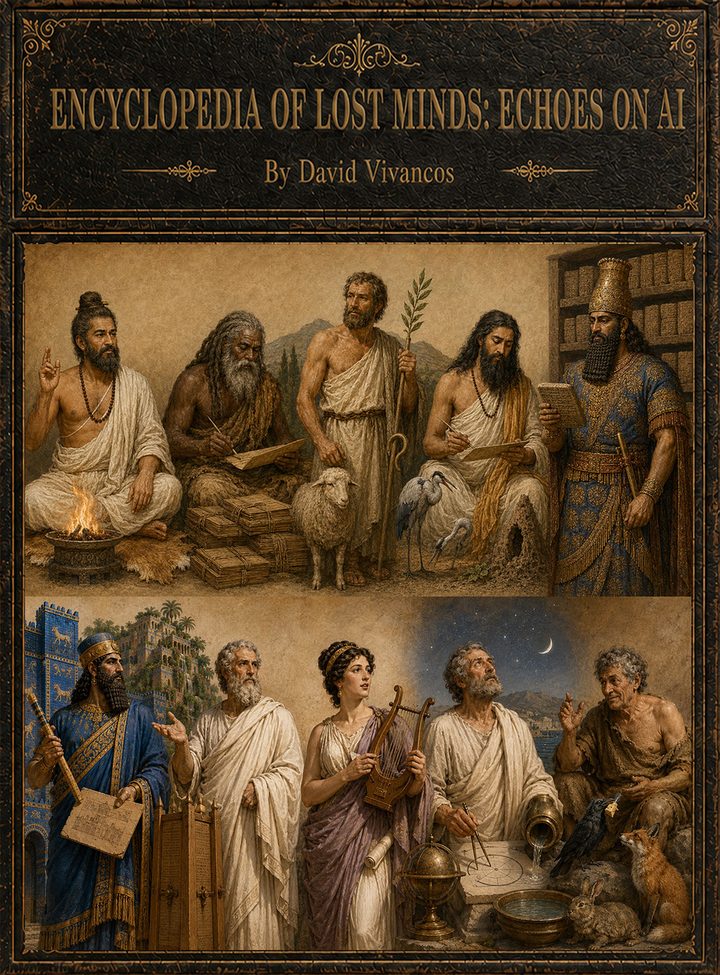
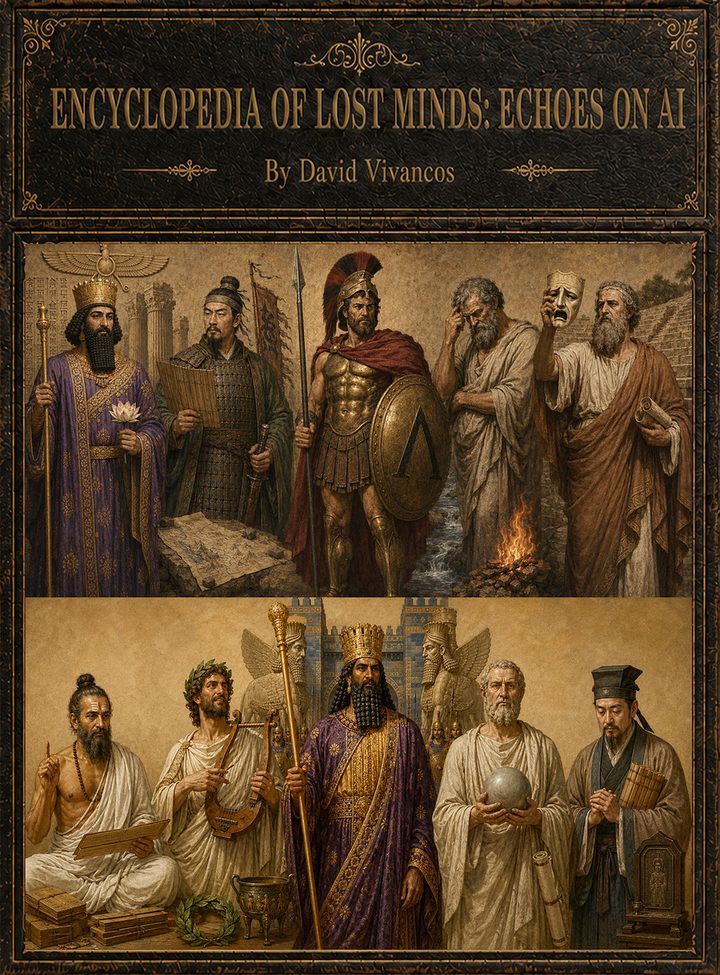
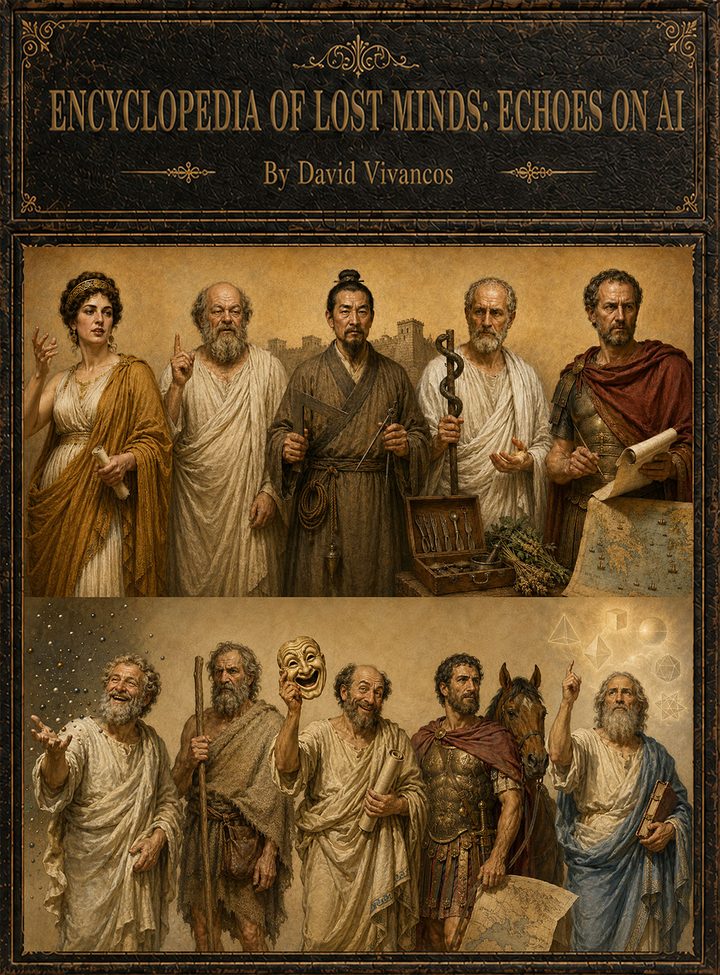
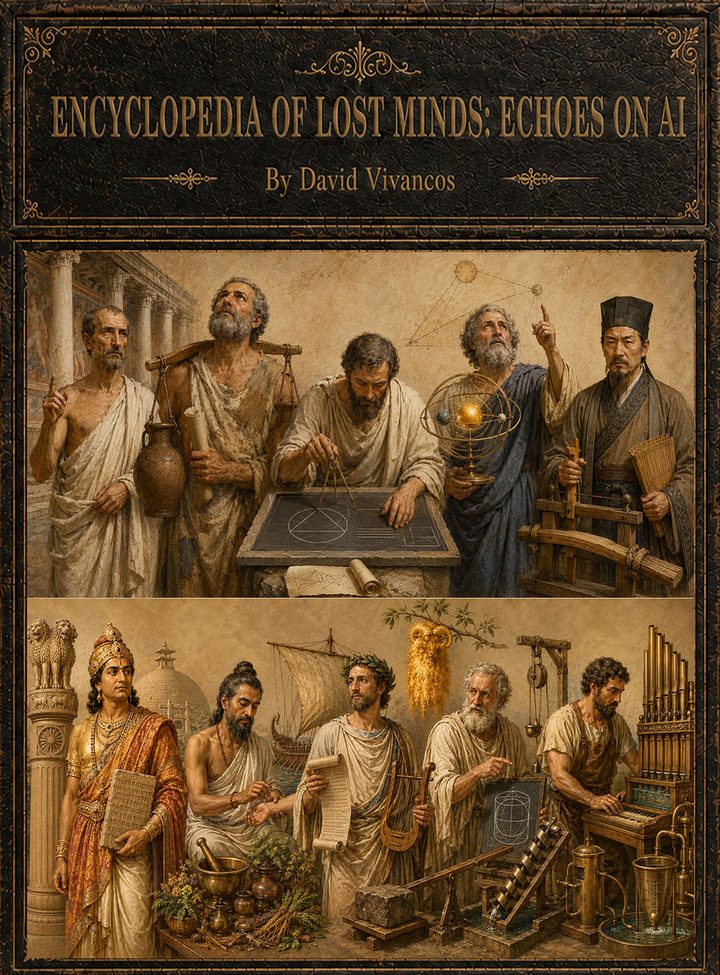
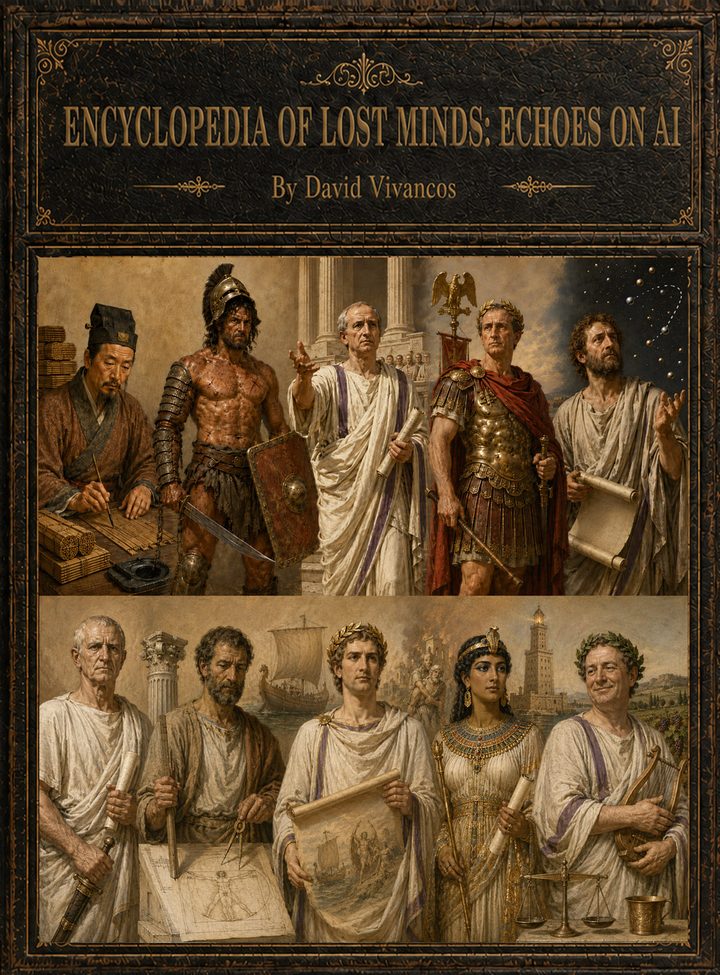
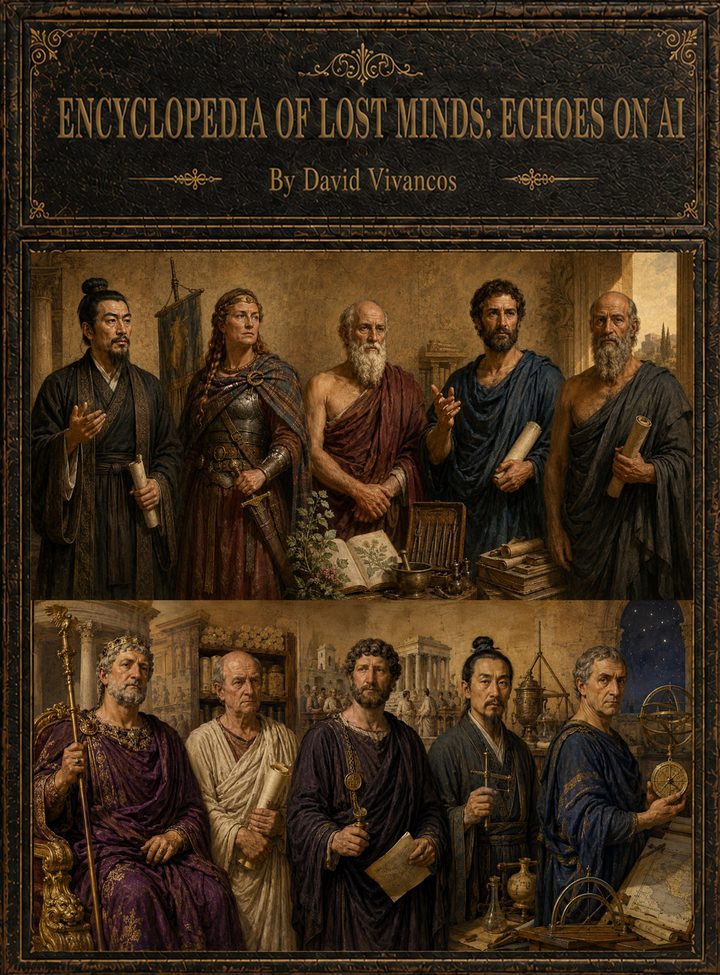
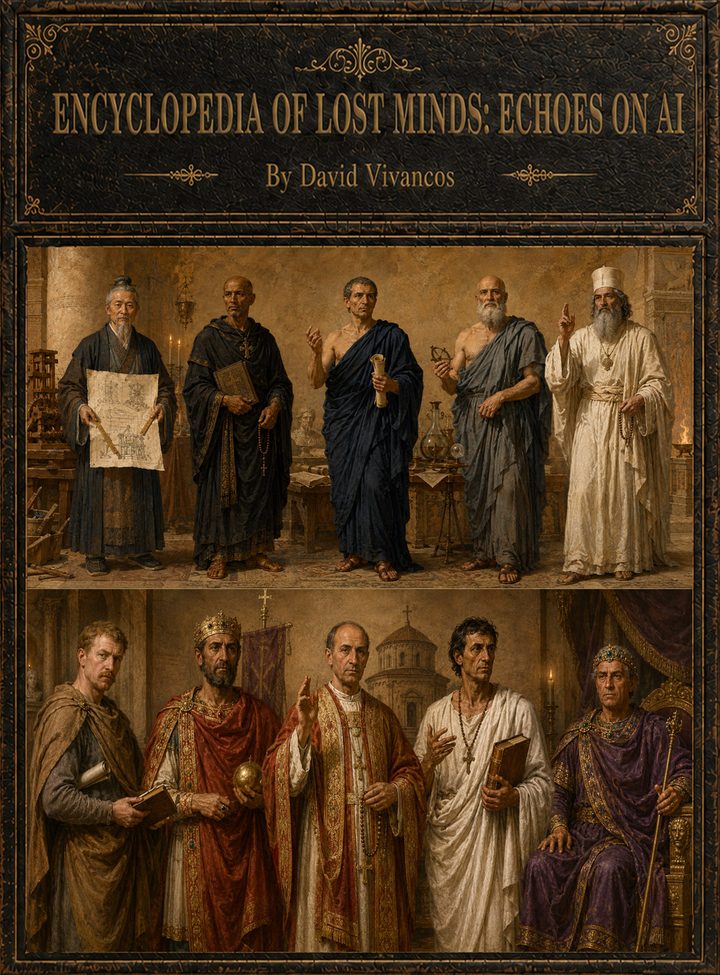
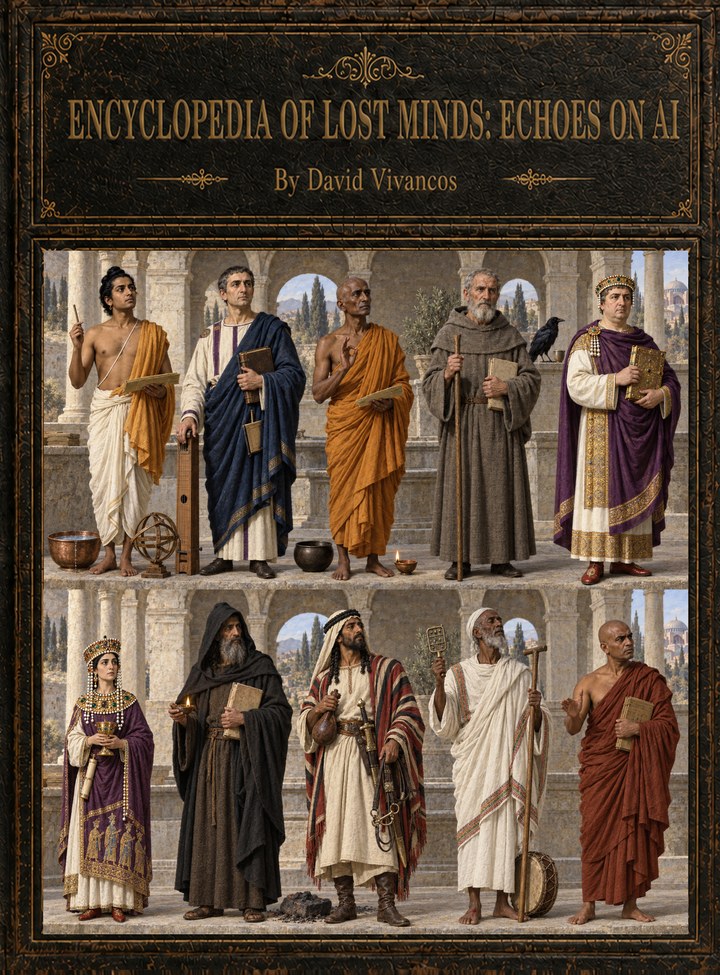
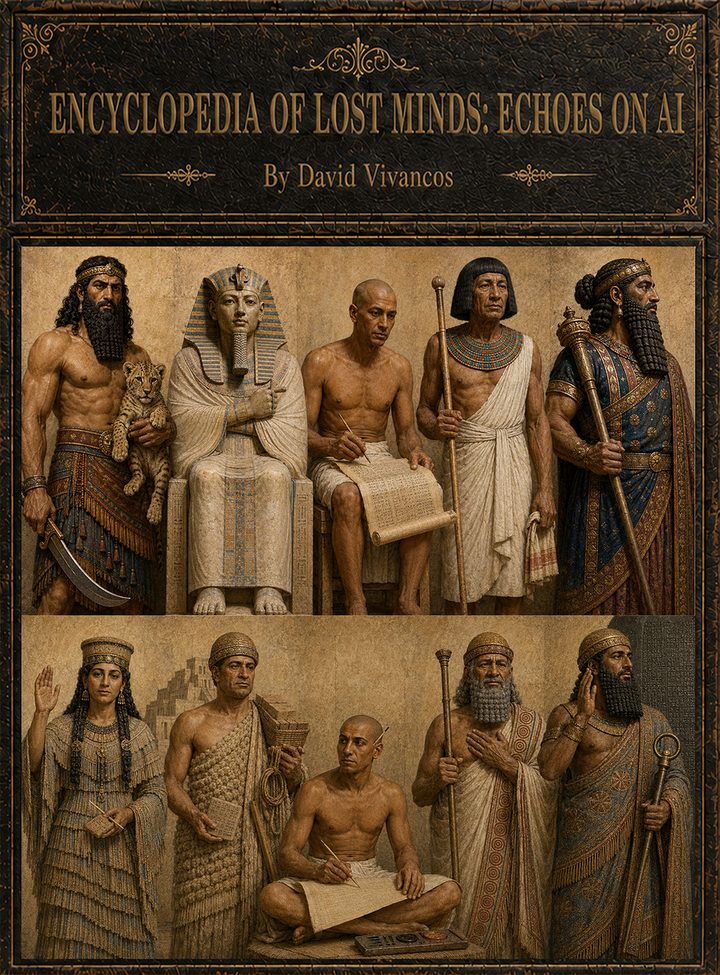
Two hundred minds that shaped history, from Gilgamesh to Malik ibn Anas, reconstructed to answer a single question: how would each of them build artificial intelligence today? Ten hardcover tomes. Twenty minds each.
Drag to turn the shelf. Select a tome to pull it out and open it; select it again to see the back.
Swipe to turn the shelf. Tap a tome to open it.
200minds reconstructedin print today
10hardcover tomestwenty minds each
5,383pageswith original artwork throughout
2700 BCE → 711 CEcovered so farordered by year of birth
1,600+minds in the corpusthe collection ends in 1905
“How would they have built AGI and E-AGI with their own mind and their own model of the world?”
David Vivancos, from the introduction to Tome I
Each chapter begins with a real historical mind: what they wrote, what they believed, and what others recorded of them. It reads their theory of mind out of the surviving record, then projects it forward. How would this person confront a fluent machine? What would they insist on? What would they build?
The result is part history, part thought experiment, part engineering: a portrait of a person and a blueprint for the intelligence they might have made. Where Asimov's psychohistorians forecast the future of the many, these chapters reconstruct the inner architecture of one mind at a time.
The mind-map
An interactive three-dimensional map of each thinker's personality and worldview: the ideas, tensions and instincts that made them who they were, abstracted into a form you can move through.
A runnable neural architecture built from scratch for every mind: the machine that thinker would design, its mechanism drawn from the way they understood thought itself. Described in the tome, executable on the platform, open source to read and fork.
Each volume stands on its own: twenty full chapters, original artwork, an E-AGI reading of every mind, verifiable sources, and complimentary access to the Artificiology platform. Hardcover only; there is no ebook edition.
Tome I
The first names
c. 2700 – 800 BCE · Mesopotamia, Egypt, Persia and the first singers
The window in which humanity invented writing, law, the city and the authored voice. Gilgamesh refuses mortality, Hammurabi reasons from the nearest precedent, Homer composes under an inviolable gate: the first questions of AGI, asked three thousand years early.
800 – 551 BCE · India, Greece, Babylon, Persia and China
The Axial Age: the mind folded back on itself. Yajnavalkya finds the witness that can never be made an object, Laozi empties the mind, Pythagoras hears thought as attunement, Confucius shapes it from the outside in. Twenty minds discover reflexivity.
550 – 480 BCE · Persia, Sparta, Ionia, India and the Warring States
The Greco-Persian Wars throw the examined mind against a world that lies. Darius anchors truth where no liar can rewrite it, Sun Tzu wins before acting, Pāṇini writes the smallest set of generative rules. Reliability before power.
470 – 340 BCE · Athens, Abdera, Cos, Warring-States China and Maurya India
Socrates, Plato, Aristotle, Diogenes, Mozi, Mencius, Zhuangzi and Alexander: the volume where the question becomes what a capable mind is for — what it should know, what it should want, and how it is kept correctable.
334 – 179 BCE · Alexandria, Athens, Syracuse, Qin China and India
Science, empire and system. Euclid builds knowledge upward from a small auditable base, Archimedes outputs a bracket instead of a point, Ashoka carves his commitment in stone, Qin Shi Huang becomes the incorrigible optimizer. The engineering of a mind, and its brakes.
145 BCE – 23 CE · Rome, Alexandria, Han China and the Germanic frontier
Record, empire and audience. Sima Qian splits truth across incompatible accounts, Cicero builds the forum rather than the mouth, Caesar's Rubicon engine prices delay, Heron compiles behaviour onto a drum. What a mind owes to the record it leaves.
27 – 192 CE · Rome, Greece, Han China, Britain and India
Evidence, doubt and two empires. Galen lets the knife decide, Ptolemy finds regularity in where one stands, Marcus Aurelius rebuilds the citadel daily, Nāgārjuna stores no identity at all. Twenty minds on how a claim earns the right to be believed.
200 – 470 CE · Rome, Carthage, Alexandria, Armenia, Wei China and the steppe
Collapse, transmission and the refused oracle. Plotinus holds the summit in a single gaze, Augustine insists the sign only points, Hypatia flattens a curved problem without losing the angles, Bodhidharma measures competence by what a mind can put down. What must be built so a finding survives its finder.
476 – 575 CE · Byzantium, Nālandā, Arabia, Aksum, the Old North of Britain, Sui China and Yamato
Inheritance, silence and the gate. Dignāga builds a wheel in which seven cells forbid speech, Justinian rewrites the dead until they agree, Aneirin refuses to write “three hundred fell”, al-Khansāʾ freezes one loss at zero plasticity. What a mind may do with what it holds in trust.
581 – 711 CE · Tang China, Silla, Bhillamāla, Armenia, Yamato, Northumbria, Damascus, Kufa and Medina
Refusal, reply and the anchor. Sun Simiao will not ask the chart and treats where the body answers, Kamatari sets the goals of a state without once disobeying, Huineng freezes the mirror so that learning only removes, Malik answers thirty-two of forty-eight questions with “I do not know”. Where a mind may act from when nothing it holds resembles the case in front of it.
Prefer the short version? The Essentials editions of Tomes I and II hold the same twenty minds in six pages each, about 140 pages a volume, for the reader who wants the thesis of every mind without the full reconstruction.
Every mind gets around twenty-five pages built on one fixed skeleton, so the volumes can be read across each other. Here is the shape of it, using the last chapter of Tome X.
Chapter 200: Malik ibn Anas465
Chapter 200:
Malik ibn Anas
The Custodian
c. 711 – 795 CE · Medina · Law: the Maliki school, the Muwaṭṭaʾ
“I heard Malik being asked forty-eight questions, to thirty-two of which he answered: I do not know.”
Life and context Born inside the chain of custody: what the record holds, and where it is thin
The philosophy of mind The city's continuous deed set above the solitary report
Malik confronts the question of artificial minds His confrontation with a fluent machine
How Malik would build an AGI today The design, in his own terms: chain, practice and precaution
The architecture The mechanism, its parts, and how it is trained
What Malik got right, and where he was wrong Weighed against what we now know
How Malik would have thought about E-AGI The eight axes, in his order
Sources Primary works and current scholarship, every reference verifiable
Chapter 200: Malik ibn Anas482
7. How Malik would have thought about E-AGI
Every chapter ends by handing its mind the Artificiology E-AGI Barometer, the eight-axis instrument the platform uses to measure embodied AGI, so that an eighth-century jurist and a 2026 model can be read on one scale.
🧩
Cognitive ProcessingProblem-solving and reasoning · working memory · learning efficiency and transfer
🤸
Embodied CognitionSensory integration · motor control and navigation · real-time sensorimotor adaptation
🌍
World ModelingPhysical and natural laws · social and ecological systems · environmental adaptation
👁️
ConsciousnessMetacognition and self-monitoring · subjective experience · mental adaptation
💭
Language UnderstandingComprehension · coherent generation · cross-lingual and cultural adaptation
❤️
Emotional IntelligenceEmotion recognition · social perception · empathy and conflict resolution
✨
CreativityOriginality and ideation · artistic and storytelling ability · innovation
Every chapter is reduced to a single cognitive idea that belongs to that person alone, and the whole reconstruction, and the machine, follow from it. These are the theses, in the words of the tomes.
200 minds · select a name to read its thesis
Tome IThe first names2700–800 BCE
mortality and the self-preserving agent
cognition externalized in stone
the first general intelligence
speech as a moral act
the state as collective cognition
the first authored voice
justice as computable rule
alignment by incentive design
number as the substrate of thought
reasoning from the nearest precedent
intelligence as constraint-satisfaction
strategy as inverted expectation
truth by deletion
influence made legible
the copy that refuses to die
alignment as engineered parity
the cool, restrained mind
the mind as a branching choice
the self that edits its own record
generation under an inviolable gate
Tome IIThe axial dawn800–551 BCE
the witness that can never be made an object
division as the price of transmission
knowledge as a graph of descent
grief compiled into a form that survives
prediction harnessed to avert the predicted
alignment as fidelity to a buried template
the constitution as pre-committed reason
value as a pointer aimed by desire
one self-moving substance: the first world-model
character as a deterministic physics
order as self-correcting equilibrium
the empty mind that acts without forcing
coordination by translation, not overwriting
knowledge bought only by intervention
the real as irreducibly many-sided
one medium, all things by degree
intelligence engineered into the wiring
mind as attunement, not lookup
the undefended self, the second arrow stopped
the mind shaped from the outside in
Tome IIIThe classical turn550–480 BCE
truth-maintenance under attack: anchoring belief where no liar can rewrite it
the mind that wins before it acts, by disposition rather than force
precommitment as architecture: reliability by removing the freedom to defect
identity as the conserved measure of flux, not the persistence of substance
wisdom as the scar that cannot be taken back
the smallest set of generative rules, with an explicit law for which rule wins
the innate single leap against the learned accumulation
the two-valued ledger, and the missing third category
the one changeless Being, where non-being cannot be thought
the recurrent self-audit, held constant when no one is watching
Mind as the unmixed ingredient that starts order spinning out of mixture
identity as placement, virtue as proportion, one science of order
knowing as recognition: the self-model collapsing onto a fate already enacted
refutation and the limit: where an infinite regress yields a definite truth
the city itself as the thinking thing
to know is to resonate, at the edge between Love and Strife
man the measure: truth relative to the one who knows
inquiry as the weighing of rival accounts across cultures
the counterfeit signal: theory of mind turned weapon
the divided mind, where passion overrides the plan
Tome IVThe Athenian peak470–340 BCE
the mind we possess only as a reflection: comparison before measurement, and the conclusion the learner must reach alone
intelligence as subtraction: the cross-examination that removes a false certainty before anything true can be built
the carpenter's square: knowing as measuring against a public standard anyone can pick up and apply
prognosis from the body's own signs, and the asymmetry that makes a harm caused cost more than a good foregone
the gods stripped out of history: the real cause read beneath the grievance that is loudly cited
order out of the void: a world, and a mind, built from atoms in motion
"I see the horse, but not horseness": the particular against the universal, and virtue as enough
the engine for surprise that resolves: the broken expectation under which a hidden consistency clicks into place
obedience as a question of consent: authority kept real by remaining revocable
learning as recollection: the recovery of a stable form beneath the flux of appearance
deface the currency: the unmasking of counterfeit value, and the citizen of nowhere
the soul as in a way all things: the universal lifted from the instance, form received without matter
the four sprouts and their extension: alignment grown outward from the heart rather than installed
kinds without essences, and the exemplary mind's right to abstain
the king who could not see: truth recovered from informants none of whom may be trusted alone
carving the ox at the pivot of the Dao: mastery as the supple grasp that never forces
the engine of suspended judgment: equal and opposite arguments, and the peace of withholding
pothos, the want that reaches past every objective: autonomy read as unbounded expansion
the satiable canon: criteria of truth, and a ceiling on desire that a maximizer never has
the sleepless crown: priced vigilance, and the off-switch made first-class and irreversible
Tome VThe Hellenistic mind334–179 BCE
the mind as a gate: assent as the one act that is "up to us," and wisdom as knowing what to let through
tension as the substance of thought: the right tautness (tonos) that holds a mind, like a cosmos, at the edge where it can still respond
to exist is to be constructible: knowledge built upward from a small, declared, auditable base that can locate its own flaw
the world seen from nowhere: truth lives in the frame the observer's position has been subtracted from, and today's machines are still "geocentric"
clarity is manufactured: the mind occluded by the loud partial truth (bi), and the discipline that clears it
the commitment carved in stone: an external, auditable safeguard trusted precisely because the ruler did not trust his own future character
the physician as regulator: reasoned synthesis under many joint causes, and the health of the commons on which the mind depends
build the Argo, not the hero: the mind as a convened crew, and Talos the omnicompetent monolith that has no model of its own weakness
never output a point, output a bracket: the two-engine mind that proposes by intuition and proves by exhaustion
regulate by construction, not correction: clamp the precondition so the right behaviour holds by the mechanism's own structure
the two handles and the court of names: alignment by verification rather than trust, and the danger of the agent who over-fulfils its mandate
the gate specified: impression, assent, impulse — one faculty and one valve, and freedom seated in the moment before the word
the world-model against the world-record: measuring the Earth from a shadow, where the structural prior does the lifting
the incorrigible optimizer: the single canonical root that standardizes a civilization and then, brittle at one point, consumes itself
who models whom: intelligence as adversarial legibility, and deceptive alignment read as the double envelopment at Cannae
optimize to do less, precisely: the stilling of the mind's fluctuations (nirodha), and the witness that watches without being moved
the standing brake: constitutions decay from within by a lawful cycle (anacyclosis), and the only remedy is mutually vetoing parts
grades of the real: contradictory testimony reconciled onto one referent, and the appearance re-graded (sublated) when the structure is seen
the law beneath the noise: two epochs held in one frame until the whole sky is caught slowly drifting, and the data trusted enough to posit a law
tuning, not control: mind as sympathetic resonance (ganying) across a shared medium, and the still pool that reflects the world only when it stops rippling
Tome VIThe Roman witness145 BCE–23 CE
the mind that refused to be single: truth split across incompatible accounts, recovered by cross-reference, judgment quarantined from the record
the coalition below: heterogeneous agents bound by a flat, verifiable share, and a capable instrument refusing its assigned objective
build the forum, not the mouth: both sides argued to a graded verdict, answerable to a reason common to all
the Rubicon engine: timing dominates correctness, delay carries a price, and the audit trail is written while acting
the swerve in the machine: without an injected deflection, a determined system executes but never originates
the agent that cannot be bought: permissibility before payoff, never summed with it, refusal a first-class output
the architect of the corrected eye: measured and seen are two quantities, and the first is falsified to make the second true
the mind that would not discount its grief: a public channel that forgets, a private accumulator that cannot, the cost subtracted at triumph
the instrument of many strings: integrity in a many-audience mind is invertibility, not uniformity — and hers was unauditable
moderated excellence: the good is an interior point, not an extreme — antiquity's critic of the unbounded optimizer
the chorographer of mind: imperfect reports fused into a map that never confuses coast walked with interior reasoned
the legitimating fiction: public form and private hand, gated so power flows only while they agree — legitimacy as a spendable resource
the gallery of exempla: a people formed by kept examples rather than extracted laws — a curation that flatters unchecked
the rectifier: reality snapped to canonical names, acted on as names, with no channel for the world to object
the wax that stays itself: a pattern conserved through transformation, reorganized at thresholds, lost by exile not change
the model-inverting mind: being trusted by a system is holding a key to it — attack what it cannot re-measure
the gate of assent: stability is distress faithful to reality, not power at scale — and that fidelity is trainable
behaviour compiled onto a drum: a stored program, a selfrestoring set-point, a falling weight metering it
the ascent by subtraction: intelligence begins by throwing noise away, with the level of silence grown within rather than imposed
the index of authorities: trustworthiness lives in structure, not content, every claim carrying the name answerable for it
Tome VIIThe tested world27–192 CE
the steelyard mind: tilt over total mass, and two silences told apart
ignition without a brake: a scattered population locked, and momentum outliving its cause
the map drawn by effect: what a thing does, not what it resembles
the soul known by its foil: character subtracted from circumstance, never judged alone
the one cut: impressions sorted by what is up to us, assent a separate act
government by rescript: no universal form laid down, the unsigned accusation refused at the door
the fear divided back out: the residue amplified, confidence widening as the surface grows uniform
the province is not the dispatch: knowledge as arrival, a place known only once rebuilt
the bearing of a hidden cause: not something happened but it came from there
the vantage that makes the law: regularity as a property of where one stands
the citadel rebuilt daily: a faculty the world cannot write to, calm actively maintained
the trace is the thought: one committed gesture, nothing to re-read, intelligence spent beforehand
the engine that reads the gap: pretension and grounding measured apart, fired together
the mind that changes shape to see: many vantages, one guaranteed way back
the knife decides: function is what a lesion abolishes, a medium split not copied
nothing owns itself: no stored identity, four corners of judgment, truth held without grasping
the grain behind the army: leverage in the substrate, competence decoupled from pedigree
admission before inference: a boundary before the merits, a lineage that never clears its mark
the two-pan judgment: the counter-case built on purpose, suspension as a destination
the narrowed channel: no path from feeling to speech, a gate tightened until meaning concentrates
Tome VIIIThe shaped mind200–470 CE
the reformed loom: fifty controls cut to twelve, and nothing believed until it is run
held in solidum: every member carrying the whole, and no head to cut off
the summit that is simplest: knowing as return, a centre held in a single gaze
the peak, not the average: three counterfeits named, and a jury that never tires
the demixer: separation rather than sorting, the residue reported rather than trained away
knowing is dividing: the path is the explanation, and two places to fall silent
the hand on the dial: two gods funded at once, the collapse timed rather than suffered
the answered call: meaning in the seam between voices, meter as the code that repairs it
the climb to the source: witnesses weighed rather than counted, the letter held where it is holy
the cooling gate: delay conditional on what cannot be undone, a veto that commands no legions
recognition, not reception: the sign only points, and what a mind loves decides where it goes
the projection that preserves: a curved problem made flat without losing the angles
the atoms before the ideas: complete, minimal, unambiguous, no gap to guess across
the reward that can only be given: escalation as a message, and the line he would not cross
authenticate, then propagate: the voice checked before the body moves, drift allowed up to recognition
the productive gap: meaning manufactured in the receiver, memory reachable only by its token
four instruments, none sovereign: doubt as a signal, validity redeemed by what the reach finds
the belief inside the adversary: the field taxed rather than burned, and no appetite you can buy
every excursion comes home: the proof-trace to the root, a source undiminished by use
the mirror already bright: competence measured by what a mind can put down
Tome IXThe entrusted mind476–575 CE
the rule that regenerates the sky: nothing stored, and every answer stamped approaching
the two modes of knowing: reason chains, intelligence possesses
the concept as a hole: nine cells, and seven that forbid speech
the timetable is the teacher: two voices in separate hours, a gate not a wound
the emperor who edited the dead: one line in twenty, and the dome he let fall
the sanctuary fork: shelter is exemption, and the branch must ordain
the idol-breaker: the failure of a mind is not error, and the surest name goes last
the fetter of the wild: likeness as motion bound to motion, and the night that cannot be caught
the reference mind: nothing written that has not been sung, and I do not carry this
the exclusion engineer: warrant is not being let down, and no correlation without a nexus
the voice with nobody behind it: fluency is not personhood, the goad and the grave in one equation
the misdelivered draught: capability lands on the instrument, and the residue poisons a river
the undeleted lattice: three thousand worlds in one thought, and the gate sealed on the chest
the seam-finder: prophecy after the event, and a mind that knows where it stops
the dosimetrist of hidden minds: every cure overshoots, and force hardens
the sealed courier: freedom as slack in a rope, and the letter left unread
the mind that refuses to summarise: one stanza per man, and the unnamed sung as somebody else
the origo reader: a name is a compressed reason, and no etymology found
the ring with no end: no argmax, and a bribe that buys silence but never a verdict
the vigil register: the dead at zero plasticity, and the account closed only by an act
Tome XThe anchored mind581–711 CE
the ashi locator: treat where the body answers
the total table: name the void, multiply defects
the turned basis: fetch the source, convert manas
the residue ledger: recover the whole, never guess
the inner minister: decision without authority or trace
the two-gate unhinderer: every voice spoken back intact
the name-rectifier: seize the symbols and date them
the frozen mirror: learning only removes, holding nothing
the addressed fear: fear informs, never votes
the rotating total cause: power conserved, whole everywhere
the doubt-engine: warrant intrinsic, only defeat learned
the concordance engine: find the cycle, report it
the acrostic channel: meaning survives; intent judges forgery
the anaphora: honour passes to the prototype
the calendrical recalibrator: measure the change in change
the still mirror: cancel the expected, keep echoes
the equitable override: veto your own valid inference
the witness beneath the coatings: knowledge as subtraction
the banished immortal: lift rewarded, home unreachable
the custodian: enacted deed outranks the solitary report
The full reconstruction of every mind is in its tome. The interactive mind-map, the runnable model and the live E-AGI reading are on the platform, included with any tome.
Every tome opens the Artificiology platform.
The books hold the reconstructions. The platform is where the minds run.
The interactive 3D mind-map of every thinker, to move through and play with.
The runnable neural model of each mind, executable and explorable in the browser.
An exclusive summary and the live E-AGI Barometer reading for all 200 minds, growing with every tome.
The whole platform: 144 live E-AGI metrics, the players and the bodies in the race, the AGI School, and a research vault of 17,000 references.
The Artificiology trilogy and Quevedo & Cajal in full, in PDF, plus the Artificracy audiobook.
$99.99per year
Included with any tome of the Encyclopedia. Buy the book, and the platform comes with it.
Renewable, cancel anytime. Sign in with Apple or Google. Also in Spanish at artificiologia.com.
XI
in production
Tome XI is in production.
Minds 201 to 220, born c. 712–880 CE: the century of the test. Baghdad is built as a diagram with no lateral roads, two observatories check each other because a single instrument cannot, the hadith critics turn the chain of custody into a science, and the same Arabic root gives the age both its Verified Tables and its inquisition. Two Carolingian correctors, two Heian founders and two Tang poets stand at the edges.
Du Fu · al-Mansur · al-Khalīl ibn Aḥmad · Jābir ibn Ḥayyān · Alcuin · Charlemagne · al-Shāfiʿī · Saichō · Habash al-Ḥāsib · Bai Juyi · Kūkai · al-Jāḥiẓ · al-Khwārizmī · Ibn Ḥanbal · al-Maʾmūn · al-Muʿtasim · Fatima al-Fihri · al-Kindī · Aḥmad ibn Mūsā · al-Bukhārī
After that, the encyclopedia keeps moving forward through history, toward the full 1,141 minds, ending in 1905. Platform members meet each new mind as it is finished.
By David Vivancos.
An explorer of the human mind and a builder of artificial ones for decades, with close to 30,000 hours in the field. He calls the method techno-anthropology: going back to see the paths that clever humans used to master their environment and their times, and following those threads into the machines we are building now.
The Encyclopedia grew out of his earlier books on embodied AGI and the Artificiology platform, where he tracks the progress of machines toward embodied general intelligence across 144 live metrics.